
Is Ireland Punching Above Its Weight in Europe’s FAB Construction Industry?
What does it take for a country of just five million people to become home to Europe’s only high-volume EUV chip fab?
The answer is less about size and more about the conditions needed to support a project of this scale. When semiconductor companies assess where to invest in Europe, they have to consider far more than the site itself – the availability of specialised skills, the depth of the supply chain, infrastructure, utilities, and the capacity to support a multi-billion-euro facility over the long term.
Ireland has spent nearly fifty years building exactly that. Today it’s home to over 20,000 people working in microelectronics, and 15 of the world’s top 30 semiconductor supply chain companies choose to operate here. The clearest proof point came in 2026, while Intel cancelled major planned fabs in Germany and Poland, it doubled down on its Leixlip campus with a fresh €5 billion investment, because Fab 34 there is Europe’s only high-volume EUV chip fab. When a company is walking away from billion-euro commitments elsewhere and reinvesting in Ireland instead, that’s a signal worth paying attention to.
For a country of its size, that’s a remarkable concentration of capability and the story that often gets miss
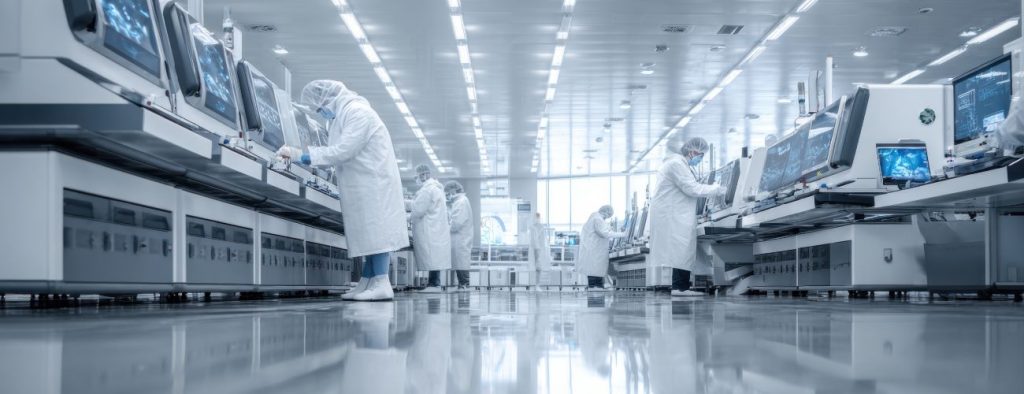
Ireland’s M&E Powerhouses
—The Delivery Layer
Semiconductor fabs live or die on mechanical, electrical and process engineering, not steel and concrete. Ireland’s M&E contractors learned this the hard way, and it built an industry.
Mercury cut its teeth on Intel’s Fab 14 project in the early 1990s, when the chipmaker’s precision requirements were unlike anything Irish construction had seen before. That project turned Mercury into a specialist in the exacting mechanical and electrical systems that sit at the heart of every fab, and it has since grown into a European contractor with thousands of employees delivering advanced technology, life sciences and hyperscale data centre projects across the continent. Three decades on, that same Leixlip campus is home to Fab 34, the site Intel just backed with €5 billion in fresh investment.
Jones Engineering, with over a century of history, has scaled into a global M&E and fire protection contractor, bringing turnkey delivery, modular manufacturing and offsite fabrication to complex builds across life sciences, data centres and advanced technology.
Suir Engineering, headquartered in Waterford, has built deep expertise across pharma, data centres and energy — and continues to expand its directly employed workforce to keep pace with demand.
Weltec Engineering, also Waterford-founded, has grown from MEP contracting into full turnkey design-and-build, with a specialism that matters enormously in this sector, with orbital and TIG welding of ultra-high-purity stainless steel systems, executed to SEMI and ASME BPE standards where a microscopic defect isn’t a minor snag, it’s a failed system.
Together, these contractors form a delivery layer capable of executing the mechanical, electrical, instrumentation and process scope that a modern fab demands, built up over decades of working alongside the same multinational clients.

UHP Equipment Manufacturers
—The Precision Layer
Beneath the M&E contractors sits an even more specialised tier, the manufacturers who build the components that actually touch the wafer’s environment.
Carten Controls, based in Waterford since 1981 and now part of Japan’s Fujikin Group, is a good example of what that looks like. Carten designs and manufactures the ultra-high-purity valves and flow systems that transport bulk gases into the fab — equipment that has to maintain contamination-free, leak-tight performance at gas purity levels above 99.99%. It’s not the kind of engineering most people ever hear about, but it’s the sort of niche capability that keeps global chipmakers coming back to Ireland.
Companies like Carten don’t just supply equipment, they anchor a local supply chain of process engineers, welders and QA specialists whose skills are directly transferable across the M&E contractors above them, reinforcing the same talent pool from both ends.
There is another part of the equation that is easy to overlook
A semiconductor fab doesn’t just require a large workforce; it needs people with highly specialised skills, engineers, technicians, electricians, welders, commissioning teams and quality professionals. Ireland’s strong third-level education base, combined with decades of experience in advanced manufacturing, has helped build a significant pool of technical talent.
But that talent is increasingly in demand. Ireland’s own semiconductor strategy recognises the challenge of building the skills pipeline needed for future growth in an already tight labour market. For companies delivering projects at this scale, the question isn’t simply whether the skills exist in Ireland – it’s how to attract, develop and retain enough of them as demand continues to grow.
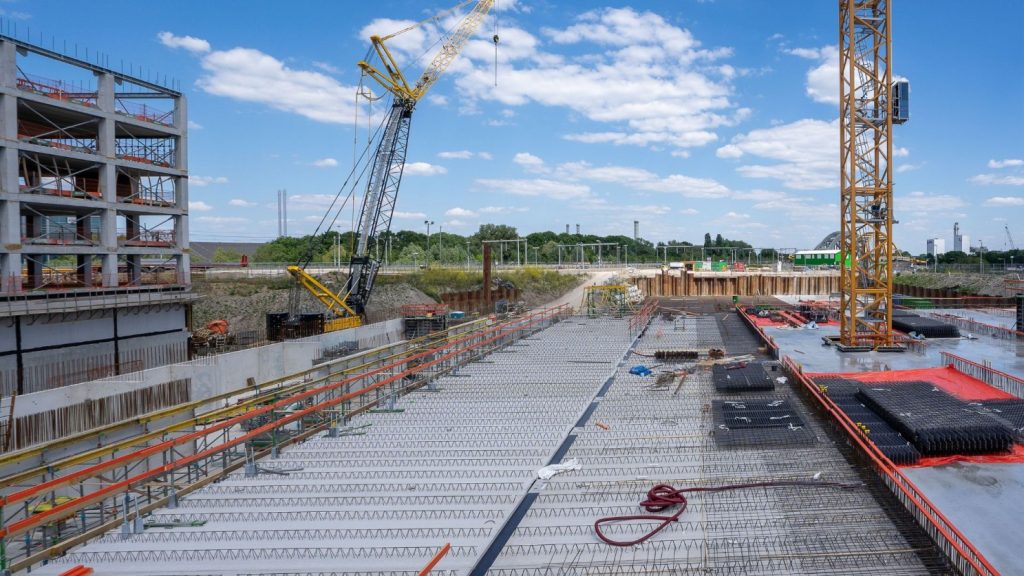
The Next Wave
And this is likely still early. Ireland’s semiconductor sector already supports over 130 companies and generates €13.5 billion in annual exports, with the Government’s Silicon Island strategy pointing to as many as 34,500 additional roles by 2040. If that scale of growth materialises, it won’t just mean more chips — it will mean another significant wave of construction, mechanical and electrical engineering, and specialist installation work across the country. The contractors and manufacturers covered here have already shown they can deliver at this level once. The opportunity now is whether Ireland’s delivery ecosystem — and its workforce — is ready to do it again, at even greater scale.
Read more: Ireland’s Semiconductor Opportunity | The Next Wave of Engineering & Construction
Why This Matters for Talent
This ecosystem doesn’t run on capital alone, it runs on people who can weld to UHP standard, read a P&ID, commission a cleanroom system, and do it all under SEMI-grade quality control. That’s a narrow, hard-won skillset, and evidently, demand for it isn’t slowing down, Ireland’s semiconductor sector is central to Europe’s EU Chips Act ambitions, and every new fab or expansion announcement translates directly into demand for mechanical, electrical, process and QA talent.
So, is Ireland punching above its weight? Judged purely on scale, it will never out-build Taiwan or the US. But when the world’s biggest chipmaker cancels flagship projects in Germany and Poland and instead puts fresh billions into its Irish site, the only high-volume EUV fab in Europe, that’s not scale talking. That’s the delivery ecosystem behind it doing exactly what it was built to do.
Partner with AA Euro Group
If your company is looking to hire experienced professionals or skilled trades and labour workers within the semiconductor, construction, engineering, or M&E industries, AA Euro Group is ready to support you.
With recruitment operations across Europe and the UK, offices in 11 countries, and a deep, established talent pool, we can help you find the right people to drive your projects forward. Get in touch with our team to discuss your hiring needs.